Tuesday, November 10, 2009

Introduction

Behind the Iron Curtain

One Woman's Journey to Self-Realization

This is the story of one woman’s life journey, the journey to a deeper understanding of herself, to the dark side of her soul as she dealt with her dependence on alcohol, and back up to the light. The journey brought her to the Soviet Union in 1981, a country still behind the Iron Curtain, where her soul-searching began. The story charts her spiritual journey as she seeks to find the core of her sacred feminine soul.

Tuesday, October 20, 2009

Behind the Iron Curtain


Prelude

Every life is a journey along the evolutionary path of the soul. If taken consciously it may lead to a higher level of vibration, an inner awareness and knowing that we are all one, each being a small drop in the universal ocean, separate on one level, but also an integral part of a single whole that moves and acts in unison, each of its parts affecting the entire entity.

This is the story of one woman’s journey at this particular stage in her spiritual evolution. Her Ego is still too large, it needs to be subdued in order to be of true service. She still needs to come to the complete and profound realization that everything is not about her. She is still too self-absorbed and vain. A case in point. She is vain enough to think her story may be of interest to other people. Yet, on the other hand, she felt an immense urge to put her story out there, an urge that could not be denied and motivated her to write it all now and not keep putting it off until some mythical later date.

She has just turned fifty-one and now seems the perfect time to turn inward. She is not completely in the third stage of life yet, she cannot yet call herself a Crone, but she has passed through the Maiden and Mother stages.


The journey has begun.


Chapter One: The Soviet Union


It was just too bad she had left her heart behind the Iron Curtain. Or perhaps it was not so bad at all, it just meant that things would be very different from now on.

That was in the summer of 1981 after she returned to the States and realized she had left a vital part of herself behind. She intuitively sensed that she would never be the same again, and if she never returned it may tear her apart. But the reality of returning seemed so remote, so unlikely, so impossible. But she was running ahead. First, she needed to go back to February 1981 when she first set foot on Russian soil.

The cold marble sterility of Sheremyetevo airport in Moscow was rather startling. It formed a sort of vacuum, a no-man’s land between where she had come from and where she was going. The smooth shiny gray expanse of the near-empty interior was reminiscent of an ice rink, she felt like running headlong across its pristine expanses, twirling pirouettes around the starkly immobile pillars, sliding and gliding along its polished floors. But she felt the foreboding stare of unseen eyes, stern and hostile, unrelenting and accusing, from somewhere she could not be certain and it sent a tremor of uncertainty that was not entirely unpleasant down her spine.

And then it was over, once beyond the sliding glass doors, huddled into a rather ancient dimly lit bus along with all the other students, and off into the dark wintry streets of the Soviet capital, that sinister scene faded and she saw a very different world. Despite the late hour and the copious February snow, the streets were alive with people in dark coats and hats scurrying along from store to store in the hope of filling their shopping bags with whatever might be available that day. The place was a-boil, like a massive anthill, each dark dot moving purposefully toward a destination unbeknown to anyone but it.

And a wild feeling of unfathomable joy and anticipation filled her. Here she was in a land of bans and prohibitions, a land of mystery locked behind the mythical Iron Curtain, a land with a bad reputation, where chains clanked, prison doors clanged, lack-luster eyes in gray drawn faces gazed forever downward, or so was the idea, but all she felt was an immense sense of liberation and exultation, the wild exhilaration of just having climbed on a roller coaster and feeling like she was in for a breath-taking and gut-churning ride.

The dorm building on ulitsa Volgina.
The dormitory she was to live in was in the south of Moscow, but the institute itself, The Pushkin Russian Language Institute, was in the center of the city, not far from the American Embassy. This meant a forty-five-minute trip every morning on the metro to get to class. And if she wanted to have breakfast at the Intourist Hotel first, where they served a smorgasbord every day for four rubles (an absolute steal), she had to be up and out of the dormitory by seven o’clock. And the smorgasbord was a darn sight better than eating the rather insipid and unappetizing fare offered at the dormitory cafeteria. Also, when she first arrived in Moscow, she was always worried she might not get enough to eat. She was seized by the unfamiliarity of being in a new and strange place where nothing was routine and the same as what she was used to at home. So just to be on the safe side, it was best to fill up in the morning and then if nothing else came along during the day, at least she wouldn’t starve. Of course that all backfired and by the time she left four months later, she had gained so much weight that she could only fit into one pair of cord dungarees that had been ample and baggy when she first arrived. But enough said about that.

For the moment she was thrilled to walk into the Intourist Hotel on many a morning before class, just breeze on in there as though she were the bees knees. Ordinary Russians from the street couldn’t do that, they would be stopped at the door and asked for identification. But she in her otter fur coat, which her mother had so kindly given her before she left (which in turn had been passed on to her mother from her grandmother on her father’s side), was a foreigner for sure, so no one asked her for identification, but waved her graciously on. How elating it was! So on she would breeze into the dining room where the buffet table just groaned with all kinds of Russian delicacies and where she would proceed to fill up for the day. After all, four rubles was nothing for her – a couple of dollars at the official exchange rate and only a dollar at the black market rate. What a bargain!

The Pushkin Russian Language Institute
Classes themselves were a bit of a bore and she did not give them much time or attention. She certainly did not rush back to the dormitory afterwards to get on with homework like most of the rest of her group did, not to mention the Middlebury crowd. They really were a serious bunch! They were the ones with the excellent Russian who even talked to each other in Russian out in the street, on the bus and in the metro, and I think they were even supposed to speak in Russian to each other in the dorms as well. That was the way it was back home in the States at their Middlebury Institute. A really prestigious place known for putting out high-class Russian specialists. She heard that the students had to speak Russian all the time on campus and you could be expelled for slipping into English! She couldn’t believe it! She heard one of them tell the story of how one guy was expelled because he forgot the rules and sang in English while taking a shower. That really cracked her up. Anyway, she was not one of them and learning Russian grammar while poring over textbooks was not the reason she had decided to try out for this program. And it certainly wasn’t the reason she had come to Russia. She wanted to learn Russian from real Russians, explore the city and have fun, not spend the whole time sitting around in the dorm with other boring Americans. Luckily her roommate was of the same mind. So after class, instead of going back home, they would set off exploring.

One of the first places they found was the Café Sever on Gorky Street, the main drag in the center of Moscow. It was an ice-cream and champagne café. That’s right, all they served was ice-cream and champagne. Oh, you might be able to get a bar of chocolate as well, sometimes, or some mineral water. But the big attraction for her was the champagne. Just imagine the luxury of sitting around in the middle of the day drinking champagne, just for the hell of it! And the other thing about most Russian cafes and restaurants was that although they brought you a menu and usually a rather elaborate one with pages and pages of different items, nothing you might want to order was actually available. So it was best just to shut the menu and ask, “What do you have today?” Usually there was one flavor of ice-cream available and one type of champagne, either semi-dry or semi-sweet. She preferred the semi-dry, but would never complain, semi-sweet would do just as well.

If they did not go to the Café Sever, another favorite place was the Ukraine Hotel on the Moscow River. It had a café on each floor. They were never all open at the same time, so you had to ride up and down in the elevator until you found the floor where the café was open at the time you wanted it. That was a trip in itself, riding up and down in the lift and roaming the thick-carpeted silent halls and corridors, looking for an open café. There you could get good cups of strong coffee and order some open-faced sandwich or a pastry. It was in one of these cafes on some floor of the Ukraine Hotel that she met her first Russians…..

She was sitting with her roommate, Lenny, drinking coffee and minding her own business, when two Russians strolled up and asked if they could join them. Well, since it was her aim to meet real Russians and converse with them in real Russian, of course she would not act all prim and proper and tell them to go away. The spokesman, Igor, although a somewhat sleazy-looking character, not very tall, rather skinny, with shaggy dark hair and a mustache, had something sultry and attractive about him. The other, Boris, turned out to be a Pole who was visiting the capital. He was really funny and also had some trouble speaking Russian, which made him immediately lovable and appealing, and he had one phrase he was fond of repeating that kept everyone laughing. Of course, she could not have known it at the time, but Igor was a black-marketeer out looking for a way to hoodwink unsuspecting foreigners into changing dollars into rubles unofficially at a supposedly better exchange rate than the official one. He also speculated in deficit goods. But such concepts were way beyond her innocent naivety at that time and she blithely went along with whatever these new friends offered. Igor had a very annoying way of switching to English though when he started talking figures. He obviously had numbers down pat so he could converse with foreigners who knew no Russian. But his atrocious accent grated on her ears and she kept telling him to speak in Russian. Plus he would snort through his rather beaky nose when he spoke in English. It really put her off!

After sitting for long enough in the café, Igor and Boris suggested they go some place for dinner. She was all for it. This was the beginning, the beginning of a whole new world for her, she always felt so elevated whenever she was wined and dined. In the weeks that followed, she saw many of Moscow’s restaurants and always felt the same excitement. There was never any rush. They would book a table for the whole evening and there was always a live band and dancing. The most important part always seemed to be the appetizers, which of course were accompanied by vodka (for the men) and champagne or wine (for the ladies). But since she was a foreigner, drinking vodka with the men was seen as something amusing and entertaining, rather than something to be scorned. So she would end up having both, vodka and champagne, and loving the sense of emancipation that came with the alcohol. Her natural shyness would disappear, the alcohol would loosen her tongue and rid her of her awkwardness about speaking Russian and her desire to only open her mouth if she knew she could get the sentence out without making a mistake. She would transform into a young woman of abandon and allure, she felt as though the world were at her fingertips, she was unabashed and courageous. She was no longer the goody two shoes who always did her homework and got good grades, who always obeyed her parents and tried to please, who was afraid to say boo to a goose or cross-talk anyone. Here in this new and strange land, away from her family and everyone who knew her, she was a queen. She was free to be someone else, free to let loose the passions she felt in her soul, free to laugh, dance, get drunk, talk to strangers, allow unknown and beguiling men to escort her around restaurants. And she also had the advantage of being better dressed that most of the other Russian women. Not that dressing fancily was something she bothered about, she did not try to keep up with the latest fashions or dress like a femme fatale. But there was definitely a difference between her clothes and the clothes of the Russian women. And she could see them looking at her and wondering with envy in their eyes.

One time a while later, when she had been in Moscow for a couple of months and the weather had already become spring-like, she was out and about on Gorky Street without a coat, wearing a deep pink velveteen jump suit her mother had given to her for her birthday before she left. Unbeknown to herself, she had been spotted and was being watched. And then she was followed home. She was very surprised when a short while after arriving back in her room, there was a knock at the door. She opened to see an attractive young Russian woman (how she had wheedled her way past the concierge on the first floor at the front door was a mystery—she was experienced obviously) smiling in her face and asking to come in. She explained that she had seen Ellie on Gorky Street in her jump suit and immediately knew she was a foreigner and had followed her back to the dorm. She wanted that jump suit and did she have anything else she would like to part with? Ellie went through her wardrobe and showed the visitor a few things, she was delighted and took them in exchange for a couple of jars of black caviar. Ellie naively agreed, she just could not refuse, and she thought the caviar would make a nice gift for someone back home. Genuine Russian caviar was a deficit commodity which was not readily available in the shops, it could only be found in certain restaurants for the elite. So she thought she was getting a good deal, and the young woman was obviously so thrilled with the jump suit that even the fact it had been a birthday present did not dissuade her from going along with her and accepting the caviar in exchange. But she failed to notice that the caviar was in jars that were not sealed properly, looked more gray than black, and once safely home proved to be far past the prime of freshness. She had to throw it out.

But back to the restaurant.
She caressed the stem of the vodka glass in her fingers and watched how the light played provocatively on the gold band painted around the rim of the glass. These glasses with their gold bands were to become a talisman for her. There was caviar and soft rolls with creamy butter. A delicious mushroom concoction in a small silver crucible topped with melted cheese. Different salads with sauerkraut, potatoes and vegetables dressed in sauce. And she looked across at the dark strange man opposite her, her eyes aglow with mischief and desire, a mysterious smile playing on her lips. And he seemed enraptured. She loved how when clinking glasses before drinking she was told to look into the eyes of the person she was clinking with. Eyes would lock in a sort of secret pact and the vodka would go down in a fiery lick, at first searing her throat, but then filling her belly with a warm and incredible feeling of pure joy.

The appetizer course and drinking vodka, accompanied by various toasts, would go on for a couple of hours, interspersed by trips to the dance floor. By the time the second course, or main dish of the evening, was served, no one could give a damn. No one was hungry any more, although it seemed people ate. But she could never be sure any more. She would be floating somewhere in a different world.

That first time though, after she and Lenny, her roommate, had been wooed and won over by Igor and Boris, they went to a floating restaurant on the Moscow River in the style of a steamship. There were small and rather cramped rooms inside, not particularly fancy or inviting, and then places out on the deck where people went to smoke and take the air after the stuffy interior. She did not smoke but she liked the smell of tobacco and found a man who smoked very attractive. Men who didn’t smoke were not real men in her book. And smoking breaks were always frequent and lingering, making the evening stretch on endlessly, so she was happy to stand by and watch while the men smoked. And she could look at the way the light reflected on the water and again feel that heady dizziness from just being there, it was all so intoxicating.

After the restaurant, Igor invited them home, to the apartment where he lived with his parents. What transpired makes it hard to understand why he did this. Why did he invite foreigners to his apartment when it was taboo? She had very dim memories of how they actually ended up at his home. But she remembered that the drinking continued and there were also some joints passed around. All caution was thrown to the wind so it seemed. The joviality continued until Igor’s father came home and, after realizing who his guests were, summoned his son for an explanation. Igor was gone for quite a while and came back ashen-faced. His father, he explained, was some bigwig in the Communist party who held some high executive post, and he had ordered the foreigners off the premises immediately. She was confused and deflated. But surely he knew the danger, why had he so deliberately gone against the rules? The upshot was even worse, but she only found out about that several weeks later. Igor himself had been thrown out of his apartment by his father for his disobedience, he was forced to find himself another place to stay, which was not easy in those days. She could not believe the trouble they had caused. And it was then that she realized she was in over her head. This was no place to take lightly, no place to breeze around without a thought to the consequences, this was a dark and sinister place with its own laws and its own rules, rules that were totally incomprehensible to a foreigner, someone who was not born and raised there.

They had been given a prep talk by their group leaders the day after they arrived. A set of instructions, do’s and don’ts. Mainly don’ts. Like don’t go straight to any of your Russian friends from the American embassy. Don’t call any of your Russian friends from the phones in the dormitory or institute. The message was clear. Foreigners seen leaving the embassies were tailed, phones at places where foreigners lived and studied were bugged, conversations were listened in to. And there were black Volgas outside all the main hotels and inconspicuous men in gray suits. They all sort of blended into the background, but they were there, and the feeling of being watched was sometimes palpable.

But that did not stop her, she still paradoxically felt that sense of liberation and freedom, as though some inner door in her soul had opened and she was free to fly to the heights she always dreamed of.

Vladimir on the Golden Ring - Shrovetide celebration
What was so alluring about the place? She just felt something awesome there right down to the marrow of her bones, in every fiber of her being. About a month into the semester, all the groups of foreign students studying at the institute went on a bus trip to Vladimir and Sudzal, two beautiful towns rich in history and culture on what is known in Russia as the Golden Ring. On the bus, she sat next to the leader of the Middlebury group. He was a Brit like herself who had lived for a long time in the States. So she felt a bond with him, both of them being ex-pats. He seemed to like her too and was very happy to sit with her and answer her questions. The main question that burned inside her was this. Did he know of any Westerners who voluntarily came to live in the Soviet Union? And not just come a live for a while because of their job or some other work, but who voluntarily chose to spend the rest of their lives there, who fell in love with the place and wanted to stay there forever. Yes, he had heard of such cases, he answered. “But most of those people seem to disappear into the woodwork,” said he. The image of a wooden house out in the country immediately arose in her mind. She could see the beams, the solid roof, the porch, the trees around it, the smoke curling from the chimney. Yes, that image satisfied her, it filled her with a wild yearning, almost sadness. Would she ever be able to fulfill that dream? So even then, even before what happened indeed happened, she was thinking about how she wanted to come and live in Russia forever.

Lake Baikal
Igor added to her cherished thoughts when he told her about Lake Baikal with its water that was so clear you could always see the bottom. An image of sparkling pure water came to mind, rippling in the sun, and through it multicolored rocks and shells, a sandy bottom aglow through the amazingly clean water. Yes, one day she would look at the bottom of that lake through that glistening water.

The Pushkin Monument
Although her relationship with Igor had shaken her up as much as filled her with pleasant surprises and memories, she continued to see him. Even after all the unpleasantness with his father. One evening in mid-March, after she had been in Moscow for six weeks, she was to meet him in the vestibule of the Pushkin metro station. She arrived on time, he was waiting for her, as were a couple of other friends. They stood and chatted for a while, but no one seemed in a rush to move on, what were they waiting for? A lively fellow with a curly blond afro, lisp, and short fur coat made of artificial leopard skin kept them entertained. Alyosha, as he was called, was particularly interested in her and told her they were waiting for another friend of his. About ten or fifteen minutes later, he appeared, she first saw him as he materialized, head, shoulders, followed by slender jean-clad hips and legs, up the escalator. He had the most striking blue eyes she had ever seen. She was mesmerized. She felt instantly drawn to him, and a spark of recognition seemed to register between them. But he was also so alien and reticent. There was a reluctance about him, as though he wished he were somewhere else. So this was the foreigner he had been dragged out of his sick bed to meet. (He told her years later that the last thing he had wanted to do that evening was go out to a restaurant with someone he hardly knew and did not particularly like, Igor that was—they only had a nodding, very superfluous acquaintance—and some foreigner. He had a fever and was up to his eyes in work, he would have much rather stayed at home. But Alyosha had been so insistent, he had finally succumbed to his pestering.) He also told her later that evening that he would have known she was a foreigner anyway, since it was not normally in the way of Russians to smile so much or have such white teeth. And she was wearing her grandmother’s otter fur coat and a wolf fur hat. Igor had been generous enough to give her a wolf fur hat, since she had found a buyer for one of his fox fur hats. He speculated in fur hats, but he had given her one for free. How proud she was of it. Although it was not a lady’s hat, it was the kind of hat men wore, but she didn’t care – it was beautiful, thick and abundant, and it suited her down to a tee.

After the introductions (his name was Ivan) and in a swoon from her love-at-first-sight experience, their small group set off in search of the evening’s adventures. She remembered huddling into the back seat of a taxi, she in the middle, squeezed between Igor and Ivan. All she was aware of was how close Ivan was, she could feel his taut thigh pressed up against hers. She could not have cared less at that moment if Igor dropped off the edge of the earth, she could not think about him any more, she no longer cared. The first stop was a beriozka shop near the Rossiya Hotel. Beriozkas were the state-run shops that only foreigners with hard currency had access to and where items were sold, particularly in the supermarket department, that ordinary Russians may have never seen their entire lives. Of course, Russians with hard currency could shop there if they took the risk. But it was hard to camouflage the fact they were Russian and being in possession of hard currency could get you a turn in prison, so it was a great risk indeed for a Russian to venture into a beriozka shop. One of the attractions was the abundance of fresh fruit, pineapples being particularly popular. Most of her other student friends would buy pineapples from the beriozkas whenever they went visiting their Russian friends. But the reason she was going to the beriozka was for booze, Amaretto (the nectar of love, as Ivan later told her), and Camel cigarettes. Alyosha also asked her to buy him cigarettes, he wanted More, he was fascinated by their length, slimness, and color. Nothing at all like any of the cigarettes available to the ordinary Russian. He just doted on her because she would buy him those cigarettes. That evening she was happy to please and again that thrill of excitement hummed through her veins as she felt the delicious unfamiliarity of all that was going on around her. Later she would feel ashamed that she had the privilege of buying things that ordinary Russians had never seen in a month of Sundays never mind have the money to purchase. What made her so privileged? Just because she had had the luck to be born in the south of England and then lived for years in the United States, just because she was from the West and did not live under communism? Once, when she left one of the beriozkas, then called Sadko, laden down with plastic bags bearing the Sadko emblem, which stuck out like a sore thumb, she was so overcome by the injustice of it all that she swore she would never go back there and buy anything else ever again. Especially when she saw Russians coming out of the local supermarket just a few doors down the street with their string shopping bags holding a few rather dismal-looking gray-wrapped packages. She went in just to have a look. Yes, there was some cheese and butter, tins of sardines, and bottles of mineral water, but not much else. She had just come out of a place almost right next door, but with blank windows and no sign on the door, ordinary Russians were none the wiser, they did not know what lay behind those white painted windows, where the shelves were groaning with almost every delicacy under the sun. It was just so unfair.

Kalinin Prospekt
But for the moment, squeezed back between her two beaus after stocking up with Western goodies, she was far from such thoughts. They were soon racing off through the Moscow streets for yet another evening of merriment and wonder. The restaurant was called Oktyabr on Kalinin Prospekt. She often caught Ivan watching her, eyeing her appreciatively, although he did not say much and seemed rather shy. But after they were seated and the vodka drinking began, he seemed to relax and sometimes tried to talk to her. Her Russian was pretty abysmal and she couldn’t really keep a conversation going, but the vodka again loosened her tongue and put a sparkle in her eyes, so talking did not seem that important. Later she found out that he had been reticent because she was supposedly with Igor, and he didn’t feel comfortable chatting her up in the presence of a rival. What to her surprise though when suddenly the band announced that the next song was for “Our guest from sunny Texas” and began playing Hey Jude by the Beatles. Ivan said he had ordered it especially for her and invited her to dance. Before she was able to accept though Igor grabbed her hand and led her to the dance floor. No! This was not what she wanted! Ivan had ordered the song for her, he was the one she wanted to dance with. She was devastated. That sneak, Igor, he was just as slimy in manner as he was in looks. She was put off him forever. She did manage to dance with Ivan later though, the band played the song again, and they slow danced to it. He was so awkward, she could tell he was not used to dancing with a partner.

By the end of the evening, she knew she had to see him again. They ended up going to someone’s apartment, he wanted her to spend the night, it all seemed like a dream, as though she was in a fog and had no clue what was going on. It was as though she were looking at everyone from the inside of a fish bowl, everyone was talking, mouthing words, laughing, drinking, but she could not hear or understand a thing. She just nodded and smiled, let them do with her what they wanted, drive her here, drive her there. She did not stay the night, Igor insisted on taking her home, but instead she ended up in a taxi with Ivan and Alyosha, traipsing off to the other end of Moscow where they lived. She had no idea at that time that her dormitory was right across the road from the apartment they had visited after the restaurant. This was Irida’s place, she was an older woman and obviously used to having all kinds of guests drop by at any time of the night or day. That’s why everyone came to see her, because her door was always open and vodka was always available, along with talk and merriment. She was an old friend of Ivan’s from way back. Ivan always came to see her when he was partying. But that night Ellie did not know she could have been back in her dorm room in ten minutes. She hadn’t the foggiest idea where she was, she just let herself be led. So she traveled home in a taxi with Ivan and then the taxi driver brought her back to the dorm. But the next morning she discovered that her wallet was missing, she had left it in the taxi along with one of her gloves, which had dropped to the floor when Ivan removed it to kiss her hand in parting.

She had Alyosha’s phone number. She called the next day, and yes, she had left her wallet and he wanted to return it, rather Ivan did. So a date was set up to meet again.

She was so sensitive and impressionable. She often likened herself to a chameleon that changed its colors to suit the situation and the environment. She could quickly change from one passion to another. What was vitally important and drove her entire being onward one day seemed insipid and insignificant the next when some new and more enticing or challenging thoughts filled her mind. So it was now. She recalled leaving the States.

She wrote in her diary on Friday, 31 January, 1981: “Boarded Eastern flight to Philadelphia. Left Mum and Dad waving in the lobby, saying goodbye was as meaningless as ever. I am suddenly alone, taking responsibility for myself for the next four months. An outer calm hides the turmoil inside, even from myself. This is the person I shall care for, cherish and look out for in the months ahead, and return loving more deeply. I will manage. I love Jason, and this, with the knowledge of his love for me, will sustain me.”

 
Yes, Jason. Their relationship had only just started to bud, but she felt very sustained by the new love she felt. Another diary entry of 6 February, 1981, written in recollection after they had already parted. “It started in the early hours of an October morning. While others slept, the stirrings of a new feeling awoke in her, and the petals of her heart unfolded. In the hazy dark before a wooden cottage, their lips met, and for the first time after ages of wanting they held each other in an embrace. In the sleepy warmth, after dimmed lights, too much wine and too much talk, they held each other under her thick quilt, in the brown coziness of her little house. She was thrilled, he was so gentle. She felt like a princess, he her knight. Many nights after that, when the budding rose, moist with dew, slowly opened within her, she thought of him as her knight, or her Greek sculpted sylph. Whether or not it was his chivalry, or his slender, almost delicate frame which reminded her of something formed from marble, or something deeper, something from his essence, his creativity, which turned her thoughts to the great thinkers of ancient history, with their fine hands sculpting fine forms, or their minds forming rare and beautiful thoughts that attracted her, she did not know. Whichever thoughts were the most appropriate, her man was a marvel; an exquisite combination of both the fine, white, knightly sculpted figure and the deep and creative mind. She loved his world of books. The way a book could come alive for him and work positively in his life, shaping his goals and desires. She longed to share his secret world of words and language, the world that made him the person he was, the person she admired, adored, and loved. This world had an enticing aura, one of mystery, enlightenment, unpredictability, and excitement. She felt that his life and world of books was something worth sharing, something that would never fall into a rut, something to invest some time and energy into, something to spend some heartache, worry, tears, pain, love, warmth, feelings, emotions, happiness, sadness, joy, and triumph on. It was unsure yet noble, weak yet strong, and it was what she wanted. It appealed to her sense of adventure and excitement, the lure that distance places had for her, a step towards the fulfillment of ideals which were still clouded and far away. Yet she could not lose track of her own identity, her own reason for living. But she loved him, and it scared her, it made her think about what she really wanted, and her heart was still full of tension and unresolved questions. Difficulties lay ahead of that she was sure, but loving him could never be wrong, it only made her happy, made her feel like a princess in the arms of her knight.”

So with this uppermost in her mind after leaving the States, all the greater was her confusion and inner turmoil when she found herself in Moscow chasing after another man, yearning for his attention, and seeking out a new meeting with him. There was so much contradiction and turmoil in her soul aroused by this wild and unfathomable country. She was filled with an unutterable recklessness, ready to do things she never dreamed of or thought she was capable of before. What a paradox, in a place where her guard should have been up, where there were so many shady places, so much she did not understand, so many invisible barriers, she felt like throwing all caution to the wind and just gallivanting on, heedless of everything. And although she felt even then somewhere deep in her soul that this was her home, that this was where she wanted to be for the rest of her life, the likelihood of it ever coming to pass was so remote it did not even bear thinking about. So again the recklessness and dare-devil intrepidity gushed to the surface, if she was only there for four months and would never be back again, she had to go to the hilt, squeeze every last drop of adventure and excitement out of this experience while she was in it, for she would never have the chance again. And she just could not get over the feeling of empowerment she felt. Never before had she felt such confidence in herself. The language was a barrier, there was no doubt about that, she felt inhibited and wished she could talk like most of the other students around her with their better schooling and more intensive language courses. Her Russian courses had not prepared for such in-depth and impressive command of the language. The only thing her two years of study in England had given her was knowledge of the Cyrillic alphabet. But she had managed to pass the O Level. Once in university in Texas, she started again from scratch. But her first professor, a Stalinist labor camp survivor who had miraculously escaped being executed by a firing squad and fled the country, had very different ideas about how to teach Russian. No grammar rules, said he, just listen to how I talk and you will know instinctively the right endings and verb conjugations. All well and good if you are living in the country and conversing every day. That’s how a child learns, by listening, absorbing, and repeating. But it hardly served well in this situation and as a result she never learned the basics of Russian grammar, never laid a solid foundation for future use. And she never had any speaking practice either. Until now. So she felt unsure of herself, especially when around the other students and during classes at the institute. She would cower in the back row hoping never to be called upon to answer questions. But once out on her own with her new Russian acquaintances, she felt wings of power unfold again. Her clumsy Russian was not a hindrance, rather Russians found her quite charming, and after a few shots of vodka, she didn’t care any more and would rattle on as much as she wanted. Often about taboo subjects like the Soviet troops in Afghanistan. What she actually said she could never recall the next day, but after that particular conversation about Afghanistan, Ivan gave her a book that laid out the Russian version of the whole situation. She never really understood it all until years later, so brainwashed was she by the West’s version. Now though, she felt empowered, empowered to talk about things she had no inkling of understanding about when her tongue was loosened by vodka. And her Russian friends only found her attempts to wax political amusing. “Kak ty govorish!” they would say with a twinkle in their eyes. But she could talk. There was no doubt it was within her capacity and so she soared on the crest of a mighty wave.

Most of the serious talk went on while they were drinking. She would accept everything that was offered her – champagne, wine from the light Georgian and Moldavian varieties to the heavy port, beer, and of course vodka. Her heart soared when she sat at the table surrounded by her friends and kept pace with the men, being clapped on the back and encouraged, told that she was “nash chelovek,” that is, “one of us.” Not a foreigner with different morals, customs, and traditions, but with a Russian soul, just like them. She felt an immense sense of belonging.

However, the drinking sometimes got to her. She found she became intoxicated very quickly, especially if she drank vodka, and often she would wake the next morning with no recollection of what she had done or said the latter part of the evening. She would remember how it all started, the joviality, the laughing, toasts, jokes, general merriment and mirth, but at some point things would get hazy, she would see and feel from a distance, as though she were watching it all from behind a glass, she was not really there. And then there would be blackouts. She knew she continued to function at these times, that is, she never passed out physically, but her mind was out, she had no further memory of what was said or done. She remembered asking Ivan about this, was it normal? He assured her it was, it happened to everyone, it was just the brain’s way of taking a rest, dealing with overdrive. So it was nothing to worry about. It did not put her on the alert, it did not caution her or warn her that perhaps she should just quit drinking. She enjoyed it too much. She enjoyed the liberation and unshackled feeling it gave her, the sense of belonging, the feeling of having the world at her fingertips. The drinking never made her physically sick, her mind would just go blank at some point, but that was apparently just a defense reaction, her brain’s protective mechanism kicking in, it was okay.

However, much of the way Russians drank appalled her. She still seemed to be able to stop at some point when she felt she’d had enough. Or she would just have to go to bed and sleep. Sometimes she would ask Lucy, the student who had been appointed head of their group, to make an excuse for her not showing up to class, say that she was sick.

There was a time at the dormitory when all the students decided to hold a big party for all the different groups of English students. She ended up drinking more than she should have and after being invited to continue partying with some of the Brits the next thing she remembered was waking up the next morning in her own bed fully clothed and with some cassette tape lying by her pillow, one she had lent the Brits the day before. She had no recollection of how she got there. Her roommate told her later that she had noticed her standing in the kitchen in a catatonic state, but she did not recall what she had done after that and how she got back to the room. Probably on zombie auto pilot. But still this triggered no warning signals, nor did it give her the slightest inkling that perhaps it was time to stop drinking so much.

The Kosmos hotel - a favorite hangout
She loved to walk the city streets in the snow and sit in the parks at dusk reflecting and soaking up the wonder of it all. One such evening in March, when the snow was still thick on the ground, and the sun was sinking toward the horizon, she walked in Gorky Park and sat for a while on one of benches. The dusky pink sun as it set that evening mirrored her heart, that mystery, that deep hushed silence, the pink quiet, she was completely content just sitting and watching, drinking in the calm and feeling a quiet joy in just being alive. What had happened since she came here was hard to explain. Very subtly, but very definitely, things had changed, she had changed, her outlook on life had changed. Life had become more complex, yet clearer and simpler. She felt she was beginning to grasp, experience, and understand feelings and ideas that were before just vague dreams, distant and unrealized. Life seemed to take on purpose and focus. She felt as though her destiny was beginning to take shape before her eyes, that she was becoming aware of who she really was and what she wanted out of life. A strong feeling of herself arose within her, she felt that no matter what happened, where she went, what she did, she was herself, true to her own purpose, aware of what was dear to her, what made her tick, what made her heart beat, what was important to her, what made her aware. All the superfluous things in life were falling away and she was looking into a crystal clear pool where she could see her reflection in all its reality. She was a worthwhile being. Looking back now, thirty years down the road, she was amazed at the insight of her young 23-year-old self. She was in the same place now, but she had not stood still, to get to where she was now she had had to go through hell, lose herself in the suffocating clutches of alcohol, take a discomfiting and often searing trip to the dark side of her soul, before she was truly able to regain herself, her worth, and her power. Sitting there on the park bench in 1981, she could not have known all this, she could not have known the journey she was about to embark on, could not have known how these four months were to awaken all the putrid, horrific, unthinkable deep and dark sides of her along with the bright, love-filled, beaming sides. She could not have known that she would take a journey to hell and back before finally finding that calm shore with its clear water for which she so yearned. Her insight back then was incredible though.

She wrote in her diary at that time: “Nothing will come without tears and pain, yet it will all be worthwhile, and I will look into the water that is so clean you can see the bottom and hear the solitary birds cry over the dusky pink marshes at sunset and feel the peace, contentment, and breath of life as it fills and elevates me. I will have my life of feelings, emotions, impressions, inexplicable joy and devastating pain. I will feel the warm dusk envelop me, see the last rose fade and the twinkling lights of the evening appear, see the reflections, the beads of life, the sweet breath, hear the sigh of peace and fulfillment and cry these tears.”

 
But there was such a contrast. She could also see the other side. Despite the calm and content in her soul, the outside the world, the harsh reality of Soviet life, often bore unpleasantly down on her. She saw a demeaning and denigrating way of life, she saw how the individual was downtrodden, humiliated, and despised, what little worth human values had against the cold gray unfeeling mechanical Soviet machinery. Yet she also understood that it was only a façade. That is was artificial and therefore destructible, it could never really crush or beat down the true hope and love that could be nurtured in the heart if people so desired. There was nothing “out there” that could defeat what was “in here” if what was “in here” came from a courageous and willing heart. So the outward rigors and deprivations of Soviet life did not faze her, she saw them as surmountable hurdles, not vast stone walls or iron hurdles that could not be brought down. The Iron Curtain was only an illusion after all. A figment of the imagination built to create the semblance of estrangement and alienation, separating men from men, women from women, women and men from each other. In actual fact it did not exist, it did not exist inside, it did not stop her from pursuing her dream of carving out a life for herself here, “behind” it.

So she continued to see Ivan. She was the initiator though and insisted on meeting with him again. She wanted her wallet back. She arranged a meeting through Alyosha and arrived outside the apartment building where Ivan lived the next day in a taxi. As Ivan told her many years later, he was sick, in bed with a high temperature, that had become even worse since the day before. So when she arrived in the taxi and wanted to see him, it was the last thing that HE wanted. But the wallet had to be returned and he had to explain that he had used some of her money to pay the taxi driver the night before, so he was now in her debt. And in spite of everything, he was obviously intrigued by her and willing, regardless of his fever, to sweep her off again into Moscow’s snowy streets. She had little memory of what happened that day. They must have gone somewhere and been drinking again. She only remembered going into some apartment building in the center, one of the old buildings with a wide stone staircase leading from floor to floor and the ancient type of cage lift. Halfway between each floor was a window with a broad windowsill spacious enough to lie down on. She remembered sitting on one them with Ivan standing in front of her, pressed against her in her avid embrace as she kissed the living daylights out of him. The friends they were with surreptitiously moved up a floor higher to leave them to enjoy their intimacy in peace. Later she ran and laughed through the snowy streets, rolling in the banks of snow piled up at the sides where pathways had been cleared for walking. She was wildly in love with Moscow, in love with life, and, it seemed, in love with Ivan. She lost her makeup purse in one of those snow drifts that night and was unable to buy any more. Cosmetics were hard to come by in Moscow those days, she did not recall every looking for or seeing any in the stores. Her roommate gave her some blush and she used it as eye-shadow, thinking it better than going without any makeup at all, she felt naked and unattractive without it. But Ivan did not appreciate the way she looked in it, he would only chide her and tell her that her eyes were all red again. He thought it was from drinking too much.

She loved being with him though. Mainly because he was so undemanding and not overbearing like most of the other Russian men she had met. Igor could get very overbearing, inundating her with questions, making plans for things to see and do, wanting to fill her time with all kinds of entertainment. She found it all too much at times. But Ivan was different. He was quiet and gentle, it seemed. He did not ask her too much, but often told her all kinds of interesting stories, historical facts, he wanted to share his country and people with her. And she knew so little! He was not too demonstrative with his feelings though, never bought her flowers or presents when they met, only once she remembered, he picked her a bunch of lilacs, when the bushes bloomed in May, along with other greenery and blossoms growing in the yards. He spoke to her of nature, of how he enjoyed fishing and mushroom picking, he shared those parts of himself that she found she understood and could share with him. Although there was a lot she did not understand, she felt a kinship with him, she felt comfortable with him on some deep, soul level.

Then there were the times he totally repulsed her and she wanted to run from him as far as possible. He would often drink too much and then something would change. He became a different person. She saw this graphically over the May Day holidays. She spent those days with him and saw a very different person after he had been drinking for two days straight. She remembered being at the apartment of one of his friend’s ex-wives. The woman was rather bitter and obviously envious of these Western girls who had come to visit. Her eyes showed a malice and coldness. But they drank and sang Beatles songs at the piano. She felt happy and gay. But Ivan became morose, clingy, demanding, he talked of his gray existence, his hard life, how the Soviet system pressed down on him and crushed his freedom, so he had to find his own escape through vodka. She could not fix that for him, it was not her fault that he had been born here and she there, she could not wave a magic wand and make everything right for him. He seemed like a lost child looking for his mother at such times, she wanted to shake him and tell him to grow up. Pouring vodka down his throat was not the answer. He talked of suicide and she felt a wall rise between them. She refused to mother him and treat him as a child. She could not stand to see him so downtrodden. The penetrating blue eyes that so thrilled her at times became lackluster and alien.

There were also times when she was totally disillusioned and felt she never wanted to see him again. He became unpredictable. They would make plans to meet, but he would not show up, and she would not know if and when they would meet again. So she found other ways to entertain herself.

Neskuchny Sad
One of the group, perhaps it was her roommate Lenny, discovered the Uncle Sam’s bar at the American Embassy. Lenny even started going out with one of the marines there. In those days, entry into the American embassy was uncomplicated and unhindered, all you had to do was wave your Western passport in the dour face of the guard on duty and you were in. It was a little Western haven in the outside alien Soviet world. You could get regular American fare in the café—hamburgers, French fries, hotdogs, Coca Cola—and the marines were all great fun and friendly, eager to meet other girls they could talk to in their own language. Then there were discos on Friday nights, so their whole student gang (the ones who did not have their noses endlessly stuck in books in the dorm) became frequent visitors. One evening a couple of the marines invited her and Lenny to go in one of the embassy cars for a ride around Moscow. What a thrill! They all piled in and took off through Moscow’s wide empty nighttime streets, some rousing Western music playing as they went, one of the marines had a cassette player with him. They stopped at Neskuchny Sad, a park by the Kremlin walls on the Moskva River. They were gay and noisy. They got out, leaving the Russian chauffeur in the car to wait for them, while they went off to explore. What laughter and joviality. They were acting with an abandon uncommon even among young people in those Soviet times. Young people did not hang out in the streets after dark, especially not drinking and smoking, nor were they loud and uninhibited. Unbeknown to them, however, they had drawn attention to themselves. How long they had been gallivanting, she did not know, before someone, one of them, saw a strange sight. Perhaps she had seen it first. She recalled moving off with Lenny in search of a place to take a pee and when she turned, there she saw it. Silhouetted against the night sky, which was lightened from the street illuminations, she could see the dark shapes of official caps, all in a row, their flat tops almost in a perfect straight line, and they were moving closer. Stealthily but surely, a ring of unknown and almost unseen Soviet officials (the KGB?) was closing in on them. The warning signal was given and they all ran pell mell back to the waiting car, tumbling in and telling the driver to drive away as quickly as possible. She could only hazard a guess at what might have happened had they been caught. Perhaps they were just curious and nothing would have happened, but better safe than sorry. Whew, a close call was all she could think.

A few days before she was due to leave, she and Ivan went to a dog show and then walked in the woods, she was in awe of their beauty. She loved the birch tree groves, the way the slender, silver trunks stretched skyward, so exquisitely pale and alluring. Later she thought of a silver birch grove as her temple, it was the place she felt most in contact with her inner spirit, with the Source of all that connected her to the rest of the universe. She and Ivan had not seen each other for a while and a bashful silence would fall between them, as though they were uncomfortable in each other’s presence and wished to be alone, but then the communion would return as they looked again into each other eyes and he pulled her close and hugged her. The woods were warm and moist, the birch trees so tender and lovely as they walked in the lush green. She felt as though she could have wandered there forever, sleeping in the long cool grass, admiring the pretty wild flowers, the pale birch tree bark, and the abundant foliage, smelling the scent of the woods and feasting on nature.

She spent the evening with Ivan, Irida and Alek. She and Ivan walked arm in arm in the scented evening air, everything so green and beautiful. She wrote in her diary later: “It had just rained, the sun was setting, the sky aglow, the rain clouds dispersing in the soft, pink hazy light. Occasionally I caught a glimpse of burning orange through the trees, the tops of the old, heavy stone, beautiful buildings were picked out in detail by the sinking sun. In the park the air was fresh and washed clean by the rain, full of the scent of apple blossom, lilac, damp grass, and earth; the scent hanging in the still evening air, full of the promise of warm summer languid days still to come, still more refreshing rain storms and beautiful, peaceful, long Moscow evenings such as these.” Another fragment from her diary after they were back at Irida’s: “Ivan was so attentive, so gentle, we laughed a lot, drank, ate good soup and healthy greens. We sat in the kitchen, as Ivan prepared the food, Alek was so entertaining, I love these people, it will be so sad to leave. Ivan wants me to stay and make a baby.”

There had been no vodka the last time she saw him, which was probably just as well. The tears he searched her eyes for were not there. They may have been welling somewhere far enough below the surface, but there was nothing to trigger them and make them flow. She kept them well hidden and realized the futility of indulging in harrowing farewells. He told her he didn’t want her to leave, that he would miss her. But both of them knew the impossibility of their being together, that she was to go back to her other world from where she was unlikely to return. Of all the places in the world to leave, this was one to which she had the least likelihood of ever returning. So he told her he loved her as a friend, implying that loving her as a woman was taboo, it could not be, there was no point in dreaming. She promised to return, she promised to write, but would she be able to come back? Did they have a future? This was something she, neither of them, could know.

Later on the plane home, she thought about how she could never explain to the ones she loved, her parents, her fiancé waiting for her, the connection she had made with the people there in Moscow. The kindred bond she felt with Ivan, a man of alien blood, upbringing, views, culture, and thoughts, was beyond description, beyond words. How could she now look Jason square in the eyes, how could she face him, she did not even know if she wanted to see him, she did not know how she would react. He had written to her almost every day for the four months she had been gone. Endearing notes filled with the daily happenings and his love for her. There had been times during this whirlwind semester when she had yearned for him so badly, missed his solidity, his familiarity, his rock-strong permanency, longed for him to whisk her up and away from all this madness, all this crazy frivolity, all this confusion, uncertainty, incredible incomprehension. He had been busy applying to grad schools for her while she was gone. He loved her, he was dependable, he didn’t drink vodka, he didn’t disappear with no explanation, he didn’t say he would be gone for an hour but not show up until the next day with no apologies, no nothing. Like that was the way people normally behaved, it was normal and nothing to get in a tizz about. But now she did not know how she would respond. Would she want to rush to him with open arms, or would she want to push him away, repulse him? She was not sure she could face the intensity of him. And she knew it would be intense. She needed time to adjust, get used to the fact she had parted with Ivan forever, get used to knowing that it had been lovely while it lasted, but now it was time to get back on with real life. She was emerging from a dream. It was as though she had been in a fantastical world conjured up by her imagination and now she was waking up. That world was dissipating like a fog, the wisps slowly turning into nothing as they evaporated in the morning sun. It had all been an illusion, but she needed time to recover. She needed time to catch her breath after her rollicking roller coaster ride, a ride that had turned the world as she previously knew it upside down. She was leaving her heart behind the Iron Curtain and things were never going to be the same again.

Chapter Two: Back in the U.S.A.

Arriving in New York was one of the most unpleasant experiences she had ever had. She was exhausted and felt frumpy and overweight in her gray corduroy dungarees, which her Russian friends had told her looked like “work clothes” – rabochaya odezhda. Not a compliment, that was for sure. And on top of everything else, because she had a British passport, she could not go through the U.S. citizen gate with all her student friends, but had to go with the non-citizens and other “aliens.” She used to laugh at that choice of word. When she later got her Green Card it described her as a “Resident Alien” – as though she had arrived from another planet! Well actually that was not so far from the truth. But now she was faced with a long wait and an even more unpleasant surprise. While in Moscow she had had to get her visitor visa extended. So now she had a large colorful stamp in her passport from the American Embassy in Moscow. The American customs people did not like the look of it, very suspicious they thought that someone had had their visa extended in Moscow, the Soviet Union. She was removed from the line and taken off to a room and told to wait. She was to be questioned. How humiliating! How absolutely awful! Here she was returning from a land of bans and prohibitions, a land of non-freedom, a land where human dignity was so frequently trampled, to the Land of Liberty and Democracy. Didn’t the Statue of Liberty stand in the harbor at the gateway to the United States of America, the Land of the Free? So why was she being interrogated as though she were a common spy or some second-class citizen? Okay, it was a formality and she did not have an American passport, but surely this was the free world, this was the West, where was the dignity? She was crushed, she was devastated, she did not belong here either. This was not her home. Was she forever doomed to roam the earth in search of a place she felt accepted and welcome? A place she could call home? It would be years before she realized that her real home could only be within. That sacred place she would later know and recognize as her spiritual home, the place she connected with her Source, the Source of all that is. But for now, faced with this humiliating situation, she managed to give satisfying answers to the officials’ questions and a couple of hours later was released into the lobby where her anxious parents were waiting. All the other passengers on the flight from Moscow had long passed through, she was the last to emerge and her parents were getting very worried. She rushed toward them, flinging herself into their waiting embrace, the dam of unshed tears that had long been building inside her finally bursting and gushing to the surface.

Her parents stayed in New York, they were there on some business, so she was free to fly on home to San Antonio on her own where Jason would be waiting. She was excited now by the prospect of seeing him, she felt relief that she would finally be back on familiar ground. But she was not prepared for what was in store. He rushed her from the airport to a Mexican restaurant for lunch. Oh, this was something you could not get in Moscow! This was something she had missed. The tangy dips, the corn chips, guacamole, salsa sauce, nachos, and of course the salt-rimmed glasses of pale green Margarita. Once settled across from each other over plates piled high with spicy delicacies, he popped the question. He asked her to be his wife. Inwardly, her jaw dropped and she felt a vast void open in the pit of her stomach. NO! Her inner voice screamed with all the force she could muster. This just could not be. She was not ready. Her whole being rose up and repelled this possibility, the very thought threatened to tear out her heart. She did not know what registered on her face, but she told him quietly that her initial response was negative, that she needed time to think. He was obliging and gave her the space she needed.

She thought about it for almost a month. Most of that time she spent in Houston at her parents’ house. And it was enough time to awaken feelings of longing, feelings that she was missing this man very much, that something was lacking in her life. The feeling she had had before Moscow of her love opening like a budding rose returned. She felt again the rippling of love for him in her heart. She asked him to come and visit. And in the pool in her parents’ back yard, she said she had changed her mind. The answer was YES. It was the beginning of July 1981.

They celebrated their wedding on September 5, 1981 at the Little Church of La Villita on the River Walk in San Antonio Texas, with the reception just across the road in the Cos House. She had dreamed of an outdoor wedding. She had wanted it to be somewhere out in the country in some lovely and picturesque spot. Texas was so flat and it took a lot of imagination to find real hills even in the Texas Hill Country. But there was Enchanted Rock, a huge mound in the middle of nowhere that espoused magnificent sunsets. This was the place, she thought, when they visited one day, panting as they struggled to the top. But then she thought of trying to ascend in high-heeled shoes and a wedding dress, not to mention dragging all the guests up there, and where would they put the tables and champagne? She had to face the fact that although it was a lovely, romantic idea, it was totally outrageous and she would have to abandon it. So the Cos House with its outside patio would have to do. There would be shelter if it should rain and the colored fairy lights strung from the beams would substitute for stars.

Interior of the Little Church of La Villita
The wedding was simple, inexpensive, but very creative and tasteful. Her mother made her dress of creamy silk and the rainbow-colored chiffon bridesmaids’ dresses for her sisters. All they ordered were the cake and the flowers. The food they prepared themselves. Nothing elaborate. For some reason she had a vivid memory of the melon balls Jason’s sister scooped out using a special gadget. They were attractive and unusual. And the highlight were the cascarones – empty eggshells filled with confetti, then to be cracked on any unsuspecting head, a Mexican tradition. She and Jason spent a few weeks preparing them, carefully chipping the tops off the eggs, draining out the contents, washing and drying the shells, dying them, filling them with confetti, and closing the hole in the top with a colorful sticker. It was a fun joint task that kept them happy for hours and made for great amusement among the guests at the wedding reception.

On her wedding day she drank too much champagne and ran barefoot along the San Antonio River Walk after most of the guests had left. They did not leave on their honeymoon that day, they spent the night in the Four Seasons Hotel, a vast luxury. They got there after midnight and she called room service to order more champagne. She was told the bar was closed and liquor could not be served to the room. She was very disappointed and quite affronted actually. What a cheek!

A week later, they loaded all their earthly belongings into a U-Haul trailer, hooked it onto the back of their rather ancient red Pinto and set off for California, where she was to continue her Russian studies at the Monterey Institute of International Studies.

They spent about ten days traveling across country, stopping at national parks to camp along the way, and hitting the Pacific Ocean at Morrow Bay. The last part of the journey took them up magnificent Highway One with its majestic views of the Big Sur Coast.

Highway One
They eventually found an apartment to rent in Seaside – the cheap and rather tacky area of the Monterey Peninsula and at a distance from the institute. Well it definitely did not have the glamour of Pacific Grove with its beachside condominiums and homes with a view, and it was certainly not Carmel, that fairytale grotto for the rich and upwardly mobile. Nor was it Monterey proper that catered to the rather classy and moderately wealthy. Seaside was for the working class, for those who scraped by on the minimum wage, and for students like herself. It was not the best, but it would do. She acquired a bike and would cycle to classes along the eucalyptus-lined roads, so fragrant after any rain. And the beach was just a stone’s throw away. She and Jason jogged or walked there most days.

MIIS proved a challenge. But then she rose to challenges. Although not without a struggle and much heart-searching. It had been a breeze to get into. Her Russian professor at Trinity in San Antonio, the one who had encouraged her to apply for the semester course in Russia, had an old catalogue. Her husband had once thought about applying to MIIS. There was an application form in the back which she tore out, filled in, and sent off. In return they sent her a more recent application form and soon after that she received notice of her acceptance. So here she was attending classes. And the classes were small and taught by native speakers. Very soon her bubble of confidence deflated. Even after her “practical” experience in Moscow, she was faced with the sober realization that her Russian was abysmal. And one of her Russian teachers was a real battle ax, very unforthcoming with her encouragement, and very severe. There were often times when she wished the floor would open up and swallow her as she struggled pathetically with her sight translations. She was ready to give up and leave.

She told Jason about this half way through the first quarter as they took their daily jog and walk on the beach. This is no good, I am way over my head, she complained. Let’s think of something else. He was taken by surprise and the last thing he wanted to do was uproot and go somewhere else (where could they go at this late stage in the game?), but he gave a good show of trying to be calm and logical. With his patient and steady reasoning he was able to change the wind in her sails. He told her he was with her in whatever she might decide, but that they should not give up quite that easily, why not keep trying. And she agreed.

The solution came when she faced the truth that she would never be an interpreter. Oral translation, simultaneous interpretation, even consecutive interpretation were not for her. She would never sit in a booth strapped to earphones in the UN. But she loved to write, she had a knack for writing, she loved the written word, and if she had the time to ponder over word choices, look things up in the dictionary, think calmly and unhurriedly, she could produce something worthwhile. Of course, she needed to understand the original first, but she discovered that her main asset was her love of her native language and her ability to express herself in it. She vividly remembered a general assembly in the institute’s main auditorium. The director of the MIIS was giving them a pep talk. To be a good translator, he told them, you have to love your native language in every way. If you have never written long letters home, if you have never kept a diary and done a lot of writing, translation is probably not for you. He was describing her to a tee. She remembered the pages and pages of letters she wrote to her parents, especially when she was in Moscow. Her father complained he had to get out a magnifying glass to read the small cramped print that would not all fit on the sheet of paper or postcard she was filling and would spread out into the margins at the top and bottom and up the sides of the page. She could not write enough. And she was an avid reader, there were so many books she had read and enjoyed, so many different authors and genres, that she would not count or list them all. So what if she dropped interpretation, picked up German again, and concentrated on written translation with two foreign languages? That was the solution.

After that things were wonderful. She had a talent, she could do it. She didn’t feel like disappearing through the floor anymore. And even though that one professor was still rather harsh and scanty with her encouragement, Ellie rose to the occasion and decided that instead of letting this woman crush her spirit she would show her just what she was made of. And she did.

Interlude: Vienna, Austria

Back garden at 444 Leopoldsstrasse, where she and Jason rented an apartment
Along with some more of the German students, she and Jason spent the second year of her MIIS course in Vienna, Austria, studying at the University of Vienna, to polish up her German. It was a very special time for her and Jason, although not easy. They made the most of it on the small amount of money they had. A student loan helped them to pay for it all, but they were still very frugal, although they did not deny themselves the luxury of traveling and seeing as much as they could. They discovered the Wiener Staatsoper (Vienna State Opera House) that had standing room for 50 Schillings (the equivalent of about 50 cents). They could not pass up the bargain and would go there several times a week to see all kinds of wonderful ballets, operas, operettas, and even catch famous singers like Jose Carreras and Maria Callas.

Vienna State Opera House


Some entries from her diary show the various stages of transition she went through and how Vienna was a city that never really captured a place in her heart.

Oct. 5, 1983
“Cold and damp. I am planning on going to class today, although I don’t know what to expect or where to go. I have to wait until F. (Jason’s brother) sends whatever the university sent me (hopefully an acceptance) before I can register. At least I know that much, but it’s like drawing blood from a stone finding out anything around here, and the university building looms impressively but impersonally. Each day feels like a marathon, it is exhausting and sucks the energy out of you. We pound the streets, swallow the cold, damp air, despair and sigh. The city is so alien and narrow, clamping tightly shut the edges of its life, closing its doors to strangers, looking inward upon its own mold and death. To draw a smile or some warmth is like trying to curl up and sleep after the covers have been wrenched aside and the morning air crisply takes hold of your toes – the only warmth left is what is inside you. Everything takes so much effort, nothing is laid at your feet – you can’t expect this, but couldn’t it be a little easier? My sensitive heart stares aghast at this world, and wilts and cringes under its icy fingers. No one wants us, no one cares – all are too busy with their narrow concerns, their heads in the sand, the dull drudgery of their lives wrinkling their skin and bending their backs lower against the biting wind. The people plod in dreary colors through their frosty lives and never think that a smile or kind word could lighten the burden of their days. Sternly they look at the world through blind, stone eyes and turn their heads to the past where ghosts dance in eveningwear and silently applaud the final act. Alive, keen minds are lost, the vital sap of life may run thickly in other lands, but here the beauty and vibrancy of lost centuries is only a tarnished luster, the brightness of their bygone youth. No bright knowledge opens doors to the warmth of its heart – the great oak doors are closed on damp mustiness where the smell of the grave turns the alert, questing mind away. Dead brown leaves clog the rushing waters of life and leave a stagnant pool of stillness.”

Nov. 17, 1983:
“It was night in Vienna. I looked down on the city from the Stadtbahn and saw how gentle the whole scene was. Soft rays from headlights and street lamps bathed the streets and the buildings in a subdued glow. People bustled about, trams clanged by, and everything had the warm, cozy atmosphere of people doing last-minute shopping before Christmas. I wouldn’t have been surprised to see snowflakes, it was the scene from a book, a children’s book about a city, a book about the safe coziness of ordinary people’s lives. The stations we stopped at were old and dimly lit, as if the Stadtbahn were Vienna’s oldest and first form of public transportation. I could have been on a train traveling across Siberia, stopping at the tiny, rundown stations, sitting on the floor of the bare carriages with the peasants and their bundles. It felt so remote, so strange, so dreamlike, as if I were in another land, at another time … I feel as though Vienna is slowly working its way under my skin, into my heart and soul and changing me. All of a sudden classes and my academic progress here do not seem as important. I am battling against the tide anyway, translating German into Russian, I am attempting an impossible task, so why not just accept it and flow with it. Just being here is better than if we had never come. Whatever happens, I will leave here richer and more fulfilled than if we had never set off on this adventure. … Reality is much more confining and restricting than dreams – one would have to be a person of unlimited physical energy and strength and be in possession of endless time (in other words superhuman, supernatural) to be able to accomplish all the tasks you set yourself in dreams. A simple mortal cannot perform the impossible. I should be content with my lucky lot in life, count my lucky, beautiful, shining stars, and smile on a world which is not so lucky.”
10 February, 1984:
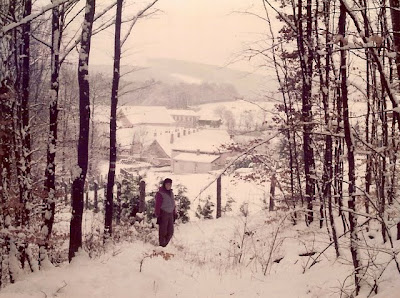
“Vienna is snowbound. Snow on rooftops and trees, snow slushy and soft in the streets, snow brown and ugly trampled by cars. We have made three trips in the snow, each time it was deeper, denser, more permanent. It reminds me of childhood winters, as taken for granted as rain or shine, just something to be put up with, exciting at first with snowmen and snowballs, then dreary and damp with soaked Wellingtons and wet clothes. Something to watch and admire from afar, but not so charming in everyday life with cold toes and gray skies. Its melting was like a sigh of relief because spring peeked through those crystal drops and sunshine made the white turn clear. Our walk today was beautiful in the silent woods, nothing can create an atmosphere like snow, but it is also sinister and deathly, penetrating and overpowering. It clings and will not leave. I try desperately to see beneath, to capture life and breathe warmth. It penetrated my brain and boots, making me want to laugh hysterically at its volume, its sheer volume, weight and oppressiveness – it was everywhere and just would not leave. Vienna cloaked in snow removes itself even further from my heart, like an ice princess, so beautiful, but deadly. I cannot love Vienna in the snow for she is too cold and cruel, too barren of feeling and vitality to ever be endearing. Our walks in Vienna’s snowy suburbs were magnificent and grand, but my heart ached and yearned all the more for sun and warmth and freedom. Snowbound Vienna is sobering and stealthy, sealing any charm behind shuttered windows and locked doors.
Aside from loving and hating snow, our expeditions have been most enjoyable. Wintry ruins in Baden with pine woods and slanting sun on creamy snow – a dipping winter’s sun creates unusual light effects which lend themselves well to romantic dreams. A children’s play park in Bisemberg with a view across the Danube to Leopoldsberg, Kohlenberg, and Klosterneuberg. Shadows on the snow from the hazy sun – walks in wintry woods do have their charm.”

They also traveled further a-field, into the Eastern bloc, to Budapest and Prague.

Prague in the spring


In her diary she wrote on 2 November, 1983: “We are on the train back to Vienna after a five-day stay in Budapest. … Budapest was a frenzied hub of people against a background of smoky skies, a slow, heaving river and the solid stone of an ancient and noble history. The grime and spittle of the much trodden streets of Pest contrasted with the majestic solidity of Castle Hill, Liberation Monument, and St. Gellert to symbolize the stifled drudgery of life under communism and the proud and stubborn spirit of the Hungarian people. For Jason and I the most lasting memory has been the walks along the Danube after dark. Budapest was not electrified by a single neon bulb at night, but glimmered in the waning yellow glow of a candle, like the moon past its prime. One night the Parliament, Castle Hill and the Chain Bridge were lit up, not brightly and garishly, but subtly like lights glowing faintly in the fog or viewed through a fine gauze, like the yellowing of old lace, the dull luster of burnished bronze, the mellow richness of autumn. It gave an air of mystery and romance like that evoked by old brown photographs of times gone by. The plenty in the stores and the ‘fashionableness’ of the Hungarian people surprised me after my experiences in Moscow. It seemed as though the people did not want for anything materially. It could have been Austria had someone not known better. To me, however, the mark of socialism was all too evident. A gray, spirit-destroying pall seemed to pervade the air, it could be seen in the people’s haunted expressions, the specter of communism and Russia’s iron grip caught in people’s eyes, it weighed on their shoulders and made them stoop against its oppression. The carefree joy, the jaunty step, the bold expression so common in the West were all painfully missing. The crippling drudgery of life under socialism, the frustration of desires, the crushing of aspirations for a better life were all to be blatantly read on the people’s faces, in their demeanor and stance.”

Prague seemed even more oppressive and under the weight of communism. They traveled there in the spring and even though the city was abloom, she still felt that sense of life being held in an iron grip. The train was to go on to Moscow. How she wished she could have traveled on to its end destination. In one of the department stores in Prague she heard Russians talking. It was like balsam to her ears. She moved closer, pretending to be interested in some of the items on a shelf nearby, just so she could listen to them talk. Prague was not Moscow, but it was as close as she could get at that time, and it awoke new stirrings and yearning in her heart.

After the year at the university was over, they took a hut-hopping trip in the magnificent Austrian mountains. Then they traveled by train through Switzerland and France to England and Scotland, visiting old friends and her relatives there.


A year later, she successfully completed the course at the Monterey Institute, then spent another two years writing her thesis, a translation of Mikhail Bulgakov’s Notes on the Cuff into English. She found a publisher in Ann Arbor, Michigan that specialized in translation from Russian into English. She wrote to them and asked if she could translate something for them that they would then publish if they found worthy. She would not be paid for it, but she would be in print. She dreamed in those days of becoming a literary translator, but no author or publisher would take a beginning translator fresh out of school seriously if they had no published works to show. Ardis accepted her conditions and after she completed her translation, they published it. In 1986, she received her Master of Arts degree in Russian and German Translation.

After she passed the professional exams at the end of the course work but had still not begun her thesis work, another long-cherished dream came true. She became pregnant. She and Jason had been talking about it for quite a while and she had wonderful visions of herself walking barefoot and pregnant on the beach. She could not wait for this to happen. They prepared carefully for the event. She went to see a gynecologist for pregnancy counseling and religiously began keeping a chart of her menstrual cycle, measuring her temperature every day and checking for other signs of ovulation. The first month nothing happened. After all their endeavors, her period came as usual. It was a blow and she decided she must be trying too hard. The following month, she resolved not to be so consumed by thoughts of getting pregnant and decided to dive headfirst into her work instead. She had plenty on her plate, her thesis translation and some professional work one of the Russian professors, who also had his own translation agency, had given her. This time it happened. She was pregnant. Her beautiful and wise daughter made her entry into the world on March 6, 1985, just four days after Mikhail Gorbachev became General Secretary of the CPSU and later President of the Soviet Union. Perestroika was about to begin. Later, this always seemed symbolic and significant to her. It marked the beginning of major changes in the Soviet Union. It began to open its doors to the outside world. And yes, her newborn daughter was indeed a wise being. She recognized this almost instantly. She remembered vividly the thoughts that came into her head when she first set eyes on her after she made her emergence from the womb. “This child is going to teach me more than I can ever teach her.” And so it came to pass. They named her Ursula. It was her choice. She read D.H. Lawrence’s The Rainbow many years ago while still in school in England. The description of Ursula as a young girl in that book had struck such a chord in her heart that she told herself then, “if I ever have a daughter I will call her Ursula.”


Apartment in Pacific Grove - second floor up the back steps
While he had long been far from her mind, Ivan began to consume her thoughts again. After they returned from Vienna, they found an apartment in a more respectable and comfortable part of the Peninsula. It was in Pacific Grove, just down the hill from the Defense Language Institute and just up the hill from Cannery Row. Later the Monterey Bay Aquarium appeared at the foot of the hill and she spent many a happy hour there with Ursula watching the fish. The beach there was cozier too. Small secluded seaweed-strewn inlets among the rocks where she would take her baby to play and sit in the sand. She loved watching the otters smash mollusks against the rocks on their chests as they swam on their backs. And there were plenty of seals too. It was here that her mind filled again with thoughts of Ivan and she began to recall in detail their time together in Moscow. Her dreams and yearning were triggered by reading back over old diaries she had kept during that time. It all seemed so illusive, beautiful, a whole other dream world that beckoned and lured. Such sweet memories. She even began writing him a letter as she sat there on the beach, but it never made it as far as the post office. She had sent him letters and even photos soon after her return in the summer of 1981. But she had never received a reply. He had most likely forgotten her and was living his own life. She did not seriously think she would see him again and did not strive for that. She was just happy that she had those memories, that he lived in a small corner of her heart, and was grateful for the time they had shared together.

Beach at Pacific Grove
But she did want to return to Moscow. One of Jason’s friends was a correspondent for the Christian Science Monitor and he happened to have been appointed to a two-year stint as the paper’s foreign correspondent in Moscow. He had invited them to come and visit. They thought about it, made plans, but the timing was just not right. She had not finished her degree, they now had an infant daughter, and then Jason’s father had a stroke. His mother was also frail and ill, she could not take care of her ailing husband on her own, so the decision was made to move back to Ocala, Florida, the town where Jason had grown up, the town where his elderly parents lived and were now in need of care.

On May 24, 1986, she wrote in her diary: “I still think of Ivan, but have not written and the burning desire to do so has subsided. I am still consumed by going to Moscow though and wonder if we have irretrievably lost our chance now that G. will soon be leaving. The desire to return to Europe eats at me still, maybe it is just because we are planning a move, and if we didn’t have to go to Ocala, we may be free to at least go to Vienna. Perhaps it is just the elusiveness that attracts me, but I cannot deny the adventure and uncertainty I yearn from life, I don’t want our lives to be predictable, I want spontaneity and wonder. I feel we can have it if we remain flexible and young at heart. Our daughter seems to respond to change and new environments, we should take advantage. I wonder if we will ever get to Moscow, now the idea of living there for two years seems appealing. Perhaps the only solution is to have another child to curb these adventurous feelings, they still threaten to tear me apart.”

In the summer of 1986, they packed up a U-Haul again with all their earthly belongings, hooked it onto the back of their brown Pinto (the red one had been back-ended by an illegal Mexican driver who took the corner too fast and crashed into it as it sat parked by the curbside outside their apartment) and headed back across country from California to Florida, stopping on the way to visit all the national parks and sights they could fit into their itinerary.

Ursula and the Apple
The three years in Ocala Florida were very productive for her at a soul level. She was lucky to have found a translation agency while she was in California that was willing to continue working with her and send her translations after she moved to the other side of the country. She began working for them courtesy of one of her Russian professors at MIIS who personally knew the guy who owned it. He was a Russian expatriate too and was just starting out in the translation business in San Francisco. He did not offer much money, but she was in no position to bargain or turn up her nose either. She was still green behind the ears and lucky to have someone willing to take her on at all, a young whippersnapper just out of school. And there was no Internet in those days, computers were just becoming the rage and she had one of the first Apples. Modems, the latest technological innovation, appeared after she had been in Florida for a year or so, but she did not have much luck using her first one. Technology was something quite beyond her grasp. So it was snail mail. Or rather Federal Express. She would receive Russian texts in the mail, translate them on her computer, print them out, then FedEx them back.

Soon after they were settled into Jason’s parents’ house with the elderly couple in tow, she did get pregnant again and on 23 July, 1987, her second beautiful daughter was born. She had immediately found a support group of women with children the same age when she came to Ocala. She attended a play group and had met some wonderful women with like-minded ideas about bringing up children. They all had one child around the same age and were expecting their second. She had never really joined groups before. But she felt an immense loneliness and need for company when they arrived in Florida. She was no longer in the midst of the campus atmosphere, going to class with other students, working hard to finish her thesis, with no spare time to think of anything else. Now in this new world, still not settled in her translation work, with a young toddler on her hands, she yearned for and sought out friends with similar experiences. And she was so blessed to find these women. First she attended structured classes at a local church, then when their children outgrew the age for those groups, they would meet on a rotation basis as each other’s homes. They also arranged a babysitting club, and later there was a reading circle they attended at the library. Through one of her new friends she found the Birth Center in Gainesville run by midwives who were advocates of natural childbirth. Right up her alley. She and Jason attended childbirth classes there. Her pregnancy was a time of budding spirituality and awakening to the callings of her soul. She made so many discoveries and had so many insights during this time. She did a lot of reading and was very in touch with the growing presence inside her. She meditated, exercised, nurtured her body and mind, prepared herself consciously for this birth. She had done this the first time too, when she was waiting for her first baby to come, but the first time is always so different. A time when there is no past experience to rely on. So she was unprepared for what was eventually to come. Although she had wanted a natural birth without hospital interference and medication, she finally had to be induced since, according to the doctor, she was two weeks overdue and way too large for any normal baby. Medicine made its forceful intrusion. The birth, hospital interventions notwithstanding, went normally, although it was longer than necessary, and the pushing phase was worrisome, since nothing seemed to be happening, no progress was being made. Was the baby too big to get through? Her doctor told her afterwards that she had arrived expecting to deliver the baby by cesarean, but thankfully the head was already showing by that time. So her daughter made her passage into the world through the birth canal. The second time, she was determined to do it all naturally and did not want a hospital birth. So the Birth Center in Gainesville had been like manna from heaven.

She wrote in her diary on 2 August, 1987, about a week after the birth.
“We didn’t realize it, but Claire means Light, and this is what she is, a ray of pure light, filled with light, and lighting our lives. My spiritual awakening during the pregnancy made me more aware of her soul and her presence as a conscious, feeling being within me. Sometimes I was overcome with the feeling of how special she is, an exceptional being whose soul had chosen us as channels to incarnate through. My decision to go to the Birth Center in Gainesville was somehow the first step along the path to the greater spiritual awareness which unfolded during this pregnancy. The fears I had about giving birth in a homelike setting soon abated and I became convinced that this was the right thing for me and that everything would go well. The power of positive thinking really worked, there was never a shadow of doubt in my mind that things would go perfectly.”

On the eve of the day her second daughter was born, she was sitting on the kitchen floor playing with Ursula. It was time for bed and she struggled to her feet to start clearing away the toys. As she stood she felt a warm trickle of water run down her legs and she look down to see her bare feet in a spreading pool of clear liquid. Her amniotic sac had burst. The story of this birth is one of joy and tranquility, it all went better and more smoothly and painlessly than she could ever have dreamed. The contractions started around 4 am after an initial trip to the Birth Center to make sure it was indeed amniotic fluid. It was, but her contractions had not yet started. She was sent home. She had no need for the castor oil bought on the way back to Ocala at midnight in a deserted Eckerds where no one, thankfully, was witness to her sopping dress and the trickle of water that continued to drip and leave a trail wherever she went. She awoke around 3.30 am with the knowledge that things had started. Around 5.00 am they set off again for Gainesville, leaving Ursula with her sister, who had come over to spend the night. Settled in cushions in the car she visualized herself rising to the crest of an ocean wave as each contraction built. Then breathed out in relief as each wave subsided again and ebbed away. She breathed in deeply and calmly each time with her eyes closed. Jason later told her that he thought she had fallen asleep, that the contractions had stopped. She recalled the early light of the new day as she looked out of the car window. The pale twinge of the last of the moon visible against the dusky pink sky. She thought about how she would sink into the hot tub when she arrived, how the warm water would buoy her along and take away the last of the struggle. But someone else was giving birth in the tub when they arrived. She would have to go upstairs to the bedroom on the second floor. At the foot of the stairs, she was overcome by an incredible irresistible urge to push. This was Jason’s shining moment, all his training at childbirth classes went into the words of encouragement he gave her as she stopped on the bottom step, gripping the banisters, unable to go on. “Don’t push, blow!!” he urged. She blew, quick sharp short spurts pushing her breath outward so that the inward urge to push would be assuaged. It worked. The moment passed and she was able to climb the stairs and get into the comfortable bed, just as though she were at home. Half and hour later the rays of the morning sun finally spilled over the horizon and filled the room with soft golden light, the midwives pulled a full-length mirror up to the foot of the bed and she raised her head to see her daughter emerge into the sun-filled world. She reached down and caressed her head. Then she took her daughter in her arms and brought her to her breast. It was perfect bonding, simple and complete.

Ursula and Claire
Soon her sister and Ursula joined them. Ursula, usually reticent and quiet in new surroundings and with new people, was ecstatic. She skipped up and down the corridor between the birthing room and the bathroom where Ellie and Claire were now luxuriating in an old fashioned bathtub on bowed legs, exclaiming: “I have a new sister, I have a new sister!” and lovingly laid out on the bed the clothes she would wear when she emerged from the tub. A few hours later they were all back home again in Ocala, their small family of three now expanded to four. And the delight and love were immense. This was the answer. Her feeling that having another child would quench her yearning for Russia had indeed been perspicacious. Now with two small daughters her days and mind were filled with new wonders and new challenges. She was consumed with their upbringing, she wanted to give them as much as she could, she wanted the involvement and the bonding, the time shared together as they grew and blossomed. She read to them, she took them on walks to the pond and the park, she sang and danced with them, she lit candles at bedtime and they prayed, she did arts and crafts, fed them natural foods, introduced the idea of leaving gifts for the fairies and angels before they went to bed and had to come up with a myriad of ideas for gifts in return. But it was all magical and fulfilling. In the time left, she translated and saved money, and Jason worked evenings as a waiter and saved money. They had a shared goal. As soon as they had enough money they would go to Moscow. So a percentage of each of her translations and a percentage of his tips were put aside each time, until finally they had the sum they thought would be enough.

In the meantime she had been in touch with her student friends from the Pushkin Institute days. The girls she had gallivanted with. Through one of them she found out that Lucy, the head of their student group who had always covered for her when she was “sick” and in no state to go to class, had married a Russian and was living in Moscow. After making a few phone calls and by a piece of sheer luck really (that sort of information was not normally given out over the phone), she tracked down Lucy. Did she call her in Moscow? She must have, snail mail would have taken too long. Anyway, Lucy was delighted to hear from her and said she would be more than happy to have her husband issue her an invitation to visit. The beauty of it was that since Gorbachev had taken the high seat, it was much easier to visit the Soviet Union. You didn’t have to be a tourist with a strictly set itinerary and live with a group in a hotel, you could be issued a private invitation to come and see friends or relatives and live with them in their home. So the wheels started turning, the process was underway. But naturally it did not go as quickly as she would have hoped and liked. It was a frustrating time. She thought they would be able to leave by the summer of 1989, but in November they were still in Ocala and the invitation had still not arrived. Then there were holiday delays and other intervening circumstances. Finally, Lucy sent the invitation for the beginning of 1990. So it would be later rather than sooner. This gave them more time to pack up and sort out all the loose ends in the States, so it was really for the best.

On 18 November, 1989, she had a dream about Ivan. She was in Moscow again and he saw her in the street and recognized her because she was wearing that same fur coat. They explored a hotel together hand in hand, so happy to be together, she saw his face turned toward her at one point and it glowed with love. Then some helicopters flew over and a huge ladder fell down from which descended some strange men, they had come to destroy. She and Ivan managed to find somewhere safe. In a meditation later, she was in a dark tunnel and Ivan came toward her and said it would all be alright, then they passed through a crack in the wall into a beautiful garden. This all had rather an upsetting effect on her, she denied the fact that she wanted to return to Moscow because of Ivan, the strength of her feelings for him scared her, and thoughts of returning to him and abandoning her family were the last thing on her mind, this was something she could not accept. But she questioned her motives for going. Was she subconsciously seeking a reunion with Ivan and still actually thinking of having a life with him? The thought appalled her. If this were so, then she would do better to stay at home. But she told herself that this was not her motive. She just had a strong attraction for Moscow, she wanted to return there to work, and then they would see. And anyway any real thoughts about a life with Ivan were pretty ridiculous at this point, after all she had had no contact with him for nine years, how could she count on anything? How did she know she would even see him again, let alone share a life with him even if she did? Anything could have happened in the interim. One of the scenarios she conjured up in her mind was she would return to find him happily married, but willing to be her friend. She would show up on his doorstep one day to be greeted by a prosperous and fulfilled family man, become friends with his wife, show each other their children, who would also become friends, and their two families would live in harmony and friendship forever after. What a dreamer she was, what an idealist. Or other thoughts would come up. He had drunk himself to death. Or perhaps he was in prison (after all, they had not been particularly cautious, she had phoned the American Embassy from Irida’s apartment, she had not been careful about covering her steps when she left that apartment and returned to the dormitory, which after all was right across the street, they had done nothing to hide their relationship, and the KGB had long arms and sharp eyes). But what good were these kind of thoughts? So she pushed them all aside and concentrated on the overwhelming task of packing up all their earthly belongings yet again, only this time into as few suitcases as was realistically feasible.

They had a garage sale and sold off as much as they could. Jason’s father had had another stroke and this time was confined to hospital, his other sisters and brother would take turns caring for his mother, so the house in Ocala was to be sold. They thought they were taking the bare essentials with them, computer, books, dictionaries, clothes, toys (the toys could have been left behind but she wanted her daughters to have things they were familiar with). They filled ten suitcases. With this load, they set off for Miami on 31 January, 1990 to board a Virgin Airlines flight to London and then take the train to Scotland where Jason and the girls would stay with her aunt and uncle while she went on a two-week scouting expedition to Moscow. The fact she was going on her own first “to check it out” filled her with such immense excitement that there could be no doubt about what she wanted. She wanted to see Ivan and the butterflies she felt in her stomach threatened to raise her off her feet with the beating of their wings and transport her to nirvana. Her rune card called for Patience, Perseverance, and Foresight through Discomfort and Inconvenience will come Growth.

Miami Airport on first leg to England.
On the way to Scotland they stopped in Sheffield to see her best friend from high school. They spent a wonderful week visiting old friends, going to pubs, taking the girls to the parks, and making trips to the shops in the town center. Doing all the things she did when she was growing up there. It was fun to touch base.